A Cup Full of Ice and a Heart Full of Joy

Those who know Becca know one thing: if there's ice available, she wants a cup full of it. Not a few cubes. Not a cold drink. Just ice. At home, at restaurants, at family gatherings - Becca is happiest when she has a cup of ice to crunch on. While many people might find that amusing or quirky, for us it was one of the earliest signs that something more was going on.
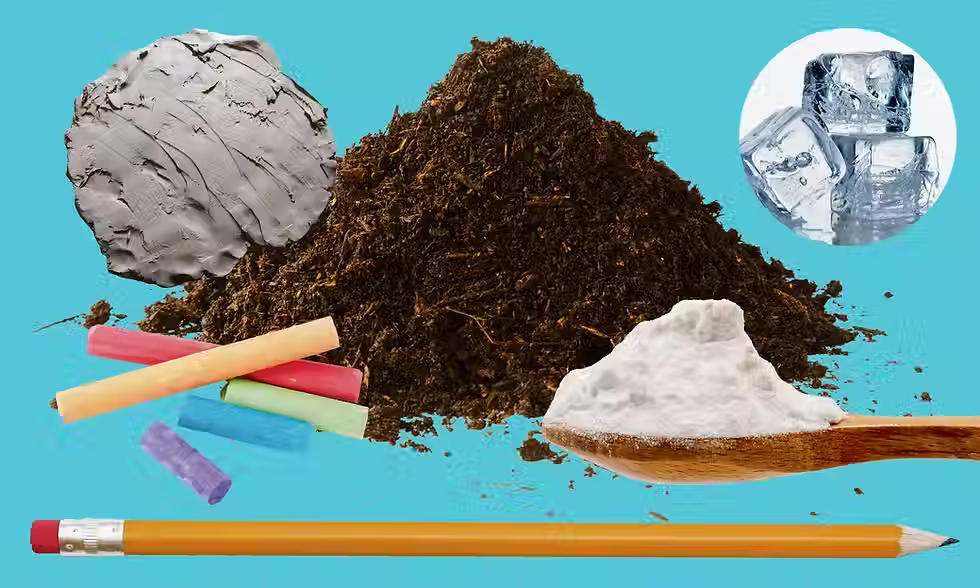
For years, Becca has been drawn to things that aren't food. Over time, we've caught her eating paper, stickers, chalk, sand, and whatever other non-food items she could get her hands on. Her pediatrician told us that most children will grow out of "mouthing" objects, that this was simply a way of toddlers exploring the world around them. But over time, what started as a means of exploration became a concern that required constant vigilance and an official diagnosis.
About two years ago, right before Becca started kindergarten, she was officially diagnosed with pica, a condition in which a person repeatedly eats non-food items. While it is common for toddlers to explore objects with their mouths, pica goes beyond normal childhood behavior. It involves a persistent desire to consume things that have no nutritional value and can sometimes be dangerous. For Becca, pica has looked different over the years. Sometimes it has been paper. Other times it has been stickers, chalk, or sand. The challenge is that once she discovers something she enjoys eating, we have to become extra alert because she may seek it out repeatedly. One of the hardest parts of pica is that many people don't realize how much supervision it requires. Most parents can allow their child to play in the yard while occasionally glancing out the window. For us, a trip to the playground or even our own backyard can mean constantly watching to make sure Becca isn't putting sand, paper, leaves, or other objects into her mouth. We have never taken Becca to the beach, because she would have an absolute party with the abundance of sand. And things that most parents are able to allow their children to engage with - stickers, art projects, schools supplies - for us, become something to manage and monitor. Even a simple walk can require heightened awareness.
I remember about two years ago, I received a call from Becca's school that she was throwing up uncontrollably and needed to be picked up. Terrified, I went to to the school to get her and the first question I asked was what they were doing when she started throwing up - and did she put anything in her mouth? Of course, as a nonverbal child, Becca couldn't tell me whether she had eaten anything she wasn't supposed to, she couldn't tell me if her stomach hurt, and the school told me that it happened so suddenly but they did not see her put anything in her mouth. Still, the doctors had to take x-rays and all sorts of extra precautions because we couldn't be sure. These are the risks inherent with pica - it can lead to choking, intestinal blockages, poisoning, infections, and other serious medical complications.
Pica is significantly more prevalent in Autistic individuals compared to the non-Autistic (neurotypical) population. While only about 2% to 4% of the general population experiences pica, rates among Autistic individuals range from 14% to 23% in children and up to 60% in adults. For many individuals on the spectrum, pica may be connected to sensory needs. For example, some children seek specific textures, temperatures, or sensations. Becca's love for ice may fit into that picture. The crunch, the cold temperature, and the sensory feedback seem to provide something her body craves.
What I've learned as Becca's mom is that behaviors often communicate something, even when words are not available. And so over the years, we've learned to adapt. We keep potentially dangerous items out of reach. We communicate with teachers, therapists, and caregivers about her pica. We pay close attention to new behaviors and environments.
I use edible materials to create items for sensory play whenever possible. I make Play-Doh out of flour, oil and water, I use Cheerios to make kinetic sand, I swap out shaving cream for Cool Whip and use rice, pasta and food coloring for Becca's sensory bins. Of course, we discourage eating the items used for play - but if she happens to eat them, I know they won't cause her harm.
And yes, whenever possible, we let her enjoy her beloved cups of ice. Not because ice "cures" pica, but because it's a safe way of getting her sensory preferences met - which has all sorts of implications for her mood, regulation, and overall functioning. Like many aspects of Autism, pica has required us to think differently, plan differently, and parent differently.
It's easy for medical diagnoses to become the focus. Autism. Nonverbal. Developmental delays. Pica.
But Becca is so much more than any diagnosis.
She is joyful. She is determined. She knows exactly what she likes. She communicates in her own unique ways. She teaches us daily about patience, perseverance, and celebrating victories that others might overlook. Becca's journey has taught us that progress doesn't always look the way we expect it to. Sometimes progress is increased safety. Sometimes it's learning a new coping skill. And sometimes it's sitting across from a little girl at dinner, happily crunching a cup full of ice, reminding us that every child experiences the world differently—and that those differences are worth understanding and celebrating.


Comments